


I have read all three of Laurence’s novels and enjoyed them tremendously. His mysteries, set in China in both modern times and the Song Dynasty, are extremely good reads. Not only are they well researched, each of his novels enjoys underlying wit, and fluidity.
twitter/X: @LwestwoodAuthor
Blue Sky: @lwestwoodauthor.bsky.social
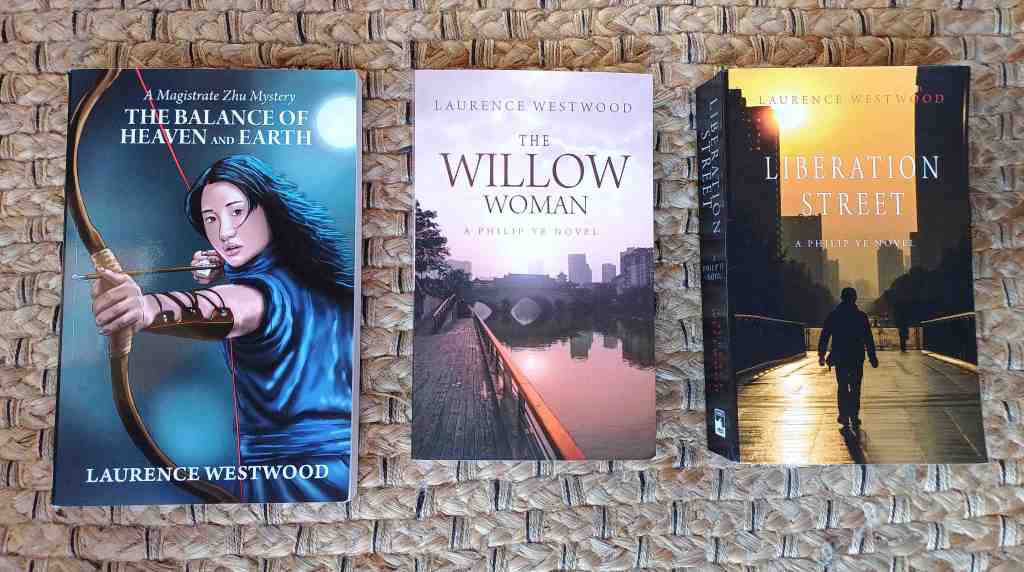
Laurence, thank you very much for agreeing to be my second “In Conversation” guest interviewee. Welcome to Lorna’s Command Centre.
Thank you for inviting me.
Let’s begin in the past.Did you read a lot as a child?
I don’t remember reading that much as a child but I do remember being taken to Birmingham Central Library by my older sister and being fascinated by all the books. My love of reading really began when I was a teenager as I became much more interested in the world.
What is your favourite childhood book? Do you still have a copy?
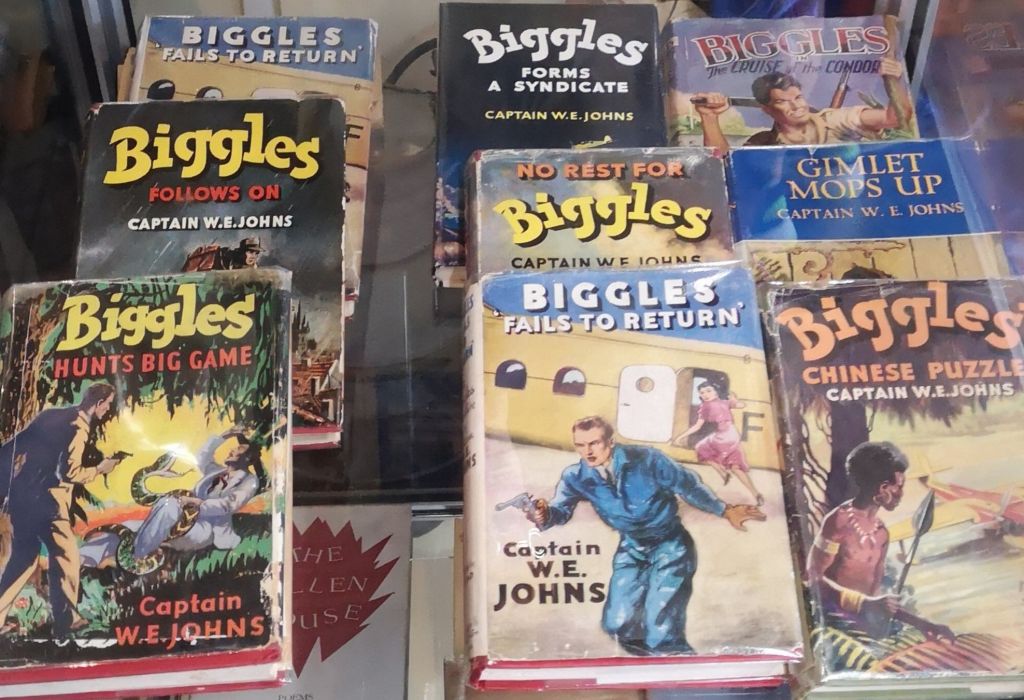
I had many of the Biggles books by W.E. Johns but they are all long gone now. This is a pity as some are very valuable nowadays. All my books from childhood have either vanished during house moves or have fallen apart because I didn’t look after them properly. Funny thing about getting older is that I have started to replace my childhood books, finding new copies of the Moomin books by Tove Jansson and the Earthsea novels by Ursula Le Guin for my bookshelves, for example!
What are you reading now?
I tend to read more non-fiction than fiction these days. Not that fiction bores me, it’s just that I have to do so much research for my own writing and I have always loved history. At the moment I am reading Cuba Libre by Tony Perrottet, a history of the Cuban revolution. I find revolutions and revolutionary societies endlessly fascinating.
I’m assuming before you began writing that you were, and probably still are, an avid reader. Do you have a favourite author?
There are two authors that were very important to me when I was growing up: James Clavell, who wrote a series of very large (!) historical novels set in the Far East; and Robert Heinlein, one of the most famous authors from the Golden Age of Science Fiction. I’m a James Clavell fan too.

Can you tell us why you like them?
James Clavell had incredible confidence and ambition. To read one of his classics, Shogun or Noble House, for example, is to enter another world entirely. As literary fashions have moved on his books now have their detractors, but they are still loved by many and are still in print. The same can be said for Robert Heinlein, who, for a science fiction author, wrote people very well, and who had an uncanny ability to create highly entertaining stories with seemingly consummate ease. Both James Clavell and Robert Heinlein were dedicated to their crafts and very disciplined in their approach to writing – something I try to emulate as best I can!
Did you always know you wanted to be an author? Did you write/tell stories/put on plays as a child?
I knew I wanted to be a writer by the time I was thirteen. I remember asking my parents for a dictionary as a Xmas present and they thought that very strange. I then went on to write stories for the school magazine but it was many years before I properly understood the discipline needed to write, and also the emotion (for me, at least) needed to propel my stories along.
Do you find time to write every day?
I try to write Monday to Friday, if at all possible – treating writing like a job. I discovered that if I wrote seven days a week I quickly exhausted myself. For me it is a strenuous activity!
Are you most inspired at a certain time of day?
I tend to write in the mornings as it is then I feel most awake and have the most energy. I am amazed at writers like Jack Higgins (famous for The Eagle Has Landed) who used to work through the night. I honestly wished I could do this. But discovering how and when you write best is very important. It takes weeks, months, maybe years to write a novel and so it’s necessary to find a working pattern that you can maintain, day in, day out. I agree.
Do you have any specific writing ritual(s) you would like to share with us?
I tend to draft first using a fountain pen, one chapter at a time. I find if I draft directly onto a laptop my mind races away and I go off in strange directions. Once the ink draft is done for the chapter, I type up, re-writing as I go. Once that chapter is typed, I will probably redraft it again in ink, then type up again… and possibly again and again until I get it right. It’s a long-winded process but it seems to work for me. I still use a fountain pen and have blotting paper in my desk, but I type my drafts.
Do you write chronologically – start at the beginning and work through to the end?
Yes, writing has to be a very orderly process for me. I think I would just confuse myself if I tried to write the ending first, for example – but see plotting below.
What is your favourite part of the writing process? eg getting down the first draft, editing, researching?
I don’t mind editing or researching, but the real joy for me is drafting the story, finding out what the novel is about, what happens to all the characters.
What is the most challenging aspect of writing for you?
I think it is easy to get disheartened when writing a novel. Novels take time and effort, and there always seems a point to me where the story doesn’t seem to be working and I can’t quite see how I am going to finish. This happens to me every time. But because I know what to expect now, I don’t worry as much. If I keep working through the ‘crisis’ then I know I will eventually get to the end and everything will make sense.
Do you plot in advance or let your work evolve?
I envy people who can plot in advance, I really do. It would make the writing process so much easier and a lot less fraught. I have a general idea what the story is about, but unless I am discovering the story myself as I am writing then it doesn’t seem real to me. I think I would get bored writing to a detailed plan. I also find that if I let the story evolve as I go, new ideas and new directions spring up which add depth to the story. This just means, though, that I have to rewrite often so that the new ideas make sense from the beginning. Interestingly, both my author heroes, James Clavell and Robert Heinlein, never plotted in advance.
What role does research play in your writing?
Research underpins much of what I do. Without the research I do not think I could credibly set stories in modern China or Song Dynasty China. Having said that, though, most research always seems to end up on the cutting-room floor! I am also not averse to changing the facts to fit the story! LOL!
Was there ever a moment when you felt like giving up on your writing?
I remember, halfway through the writing of The Willow Woman, I thought enough was enough and I couldn’t go on. I stood outside the house looking at the sunset late on a summer’s evening. As I was standing there, for no apparent reason whatsoever (it was a calm evening and had not been an especially hot day), I heard a ‘crack’ from above me and a piece of roof tile fell right next to me. I took that as a sign from the gods that I should carry on – and I am glad that I did. I, for one, am very glad that you took the sign meaning you should continue.
Does writing energise or exhaust you, or neither?
I find writing very tiring, that it takes tremendous levels of concentration to write in the way that I do. Maybe I’m doing it wrong. I console myself that Haruki Murakami runs marathons to maintain his strength to write. (I don’t run marathons, btw).
Your books – If I may quote you –
“In writing these stories of China, it is my intention to connect the distant past to the present, to cast a bright light upon a culture that has prospered for thousands of years, and, most importantly, to reflect on what is meant in China, both now and long ago, by justice and the Rule of Law.”
Can you describe the moment when the idea for your first book, “The Balance of Heaven and Earth”, came to you?
I was trying to write a novel set in England and really struggling. I couldn’t understand why I couldn’t get a novel to work. I was pondering this for days when I suddenly remembered a Japanese TV series I used to watch with my father back in the 1970s – The Water Margin – which was based on the Song Dynasty novel Outlaws of the Marsh. I suddenly got excited about writing a novel set in Song Dynasty China without, I should add, any prior knowledge of the history of the Song Dynasty. I remember instantly jotting down the four names of the constables – Horse, Little Ox, Fast Deng and Slow Deng – and laughing as I did so. I didn’t realise then how much work it would actually take to research and write the novel, but I just knew I could make it work. I also had no prior intention of writing crime fiction, but once I started thinking about China I began thinking in terms of mysteries.
Are you able to tell us anything about the Philip Ye series, “The Willow Woman” and “Liberation Street”, that we can’t find out in the blurb?
I am intending the series to be a quartet, all set in Chengdu in 2014, and following the seasons: The Willow Woman in spring; Liberation Street, summer; This Culture of Ours, which I have just started writing, autumn; and the as yet untitled fourth book to be set in the winter.
Do you have a favourite character in this series. If so, why do you like this character?
I don’t have a favourite character as such, but for reasons I don’t fully understand some are easier to write than others. I do like writing Fatty Deng’s sections. He is the procuratorate investigator, just a normal guy – almost an everyman character. Everything he says and does seems to come easily to me, unlike the other characters who are often difficult to work with and whose sections need the most rewriting.
What role does research play in your writing? Is it something you enjoy?
When I first started writing about China I had a bit of a chicken and egg problem. I didn’t know what story to write without doing any research, but I didn’t know what to research until I knew what story I wanted to write!! What solved this problem for me was doing lots of general reading about the Song Dynasty and modern China. Armed with this general knowledge, I can now approach each novel with a more specific theme. For instance, The Willow Woman is concerned with cults; Liberation Street with warfare and PTSD; and This Culture of Ours with judicial corruption and the Chinese space programme. I still do general reading to better inform myself of social conditions, either in Song Dynasty China or modern China, but with each novel having a different theme I can focus my research on new topics or themes each time. As for enjoying it, I suppose that I do. The difficulty is always making that research ‘invisible’ to the reader!
I wonder, do you write a hurried first draft and then return to edit in depth, or do you take your time in getting the initial outline on paper and edit carefully as you go along?
I tend to draft a chapter at least four times before putting it to bed, so to speak. This does not mean it will be the finished version by any means but at least I can move the story on then to the next chapter. So, in that sense, I am editing as I go. But, by the time I reach the end, it’s very possible that the beginning might need to be extensively rewritten for the story to make sense. I think many of us find the same. I certainly do. This is the drawback of making a story up as you go along. Also, wrong turns can be made. I remember reaching the end of Liberation Street and realising that the whole last quarter of the book was completely wrong. I ended up throwing away three months of work and completely rewriting it!
At a book group talk recently I was asked about the themes in my writing and whether I had a message or messages I wanted to get across. How would you respond to such a question? Personally, I write the book then notice there might be a theme.
I have been mulling this over a lot recently. I have never set out to write a didactic novel as such, and I think if I tried then I would certainly fail. That being said, I think most writers, in whichever genre they are working, cannot help but return to the same themes over and over again – because those themes form part of their natural psychological make-up. And these themes may be more obvious to the reader than the writer! When I starting writing I thought I might have deep things to say about justice – having worked in law enforcement – and, with Philip Ye being biracial, something to say about the commonality of peoples and cultures. But, as the years have gone by, I seem to care more about having fun, and writing the best story I can, than dwelling on any social or philosophical issues. This does not mean that the stories I am working on now or will work on in the future will be themeless. It is just that those themes will present themselves naturally, without planning. Like you, I might well notice them (or not LOL!) after the writing is done.
Looking to the future now, what are you currently working on?
I am just finishing off the final edits on my second Magistrate Zhu novel (The Mournful Sword), and have now begun writing the third Philip Ye novel, This Culture of Ours.
How do you think you will evolve as an author over the next decade? For example, do you envisage writing in another genre or about another country?
Writing the two final books in the Philip Ye quartet and more mysteries featuring Magistrate Zhu will easily take up the next ten years. I am not sure how I will evolve as a writer. I guess I can only hope that each book is better than the last. And I hope that my confidence in what I am doing improves year by year. I still doubt myself far too much! As for writing about another country, that is certainly possible but I can’t envisage it for now, though Cuba does interest me a great deal….
Now a few general questions.
If you could interview any author living or dead who would that be and why?
I think authors are often difficult people to interview, especially my two author heroes, Robert Heinlein and James Clavell, who were not the easiest of people to deal with. So, I will opt for Ray Bradbury who always seemed to take not only a real joy in writing but also in talking about writing. I think I would be able to listen to him for hours and hours. He would be a lot of fun!
Do you prefer to read in print or digital?
I always like holding a book in my hand. I have never read a book in digital format.
Do you listen to the audible books? I never iron without an audible on the go!
I have never listened to an audible book. I keep meaning to try one day but, when I have so many print books in front of me still needing to be read, I guess I don’t see it happening! I suppose I also enjoy silence.
What writing resources or communities do you recommend for new writers?
This is a difficult question because everyone is very different. When I started writing I read many ‘how to write’ books. These books were interesting but I think you can only learn to write by actually writing – and making many mistakes along the way. I am fully in agreement with you over this. I know some writers get a lot of benefit from writing retreats or writing groups but these have never interested me. I think it is wise to always remember learning to write is also about gaining self-knowledge: what works for someone else may not work for you. Advice such as ‘write what you know’ should also be taken with a pinch of salt. I think the best advice is to ‘write what you love’, because then, if you are enjoying yourself, the writing process will always be that much easier.
Do you think writers can improve their craft outside of writing by following other activities? For example, by travelling?
Again, I think it depends on the writer. There are some young writers who write incredible books with hardly any life experience at all. Other writers need the experience of other places and other cultures to inspire their writing. I remember the furore some years back when Stef Penney (who was suffering from agoraphobia at the time) published The Tenderness of Wolves, set in 1860s Canada, without having once travelled to Canada to research the book. What she would have learned about 1860s Canada from visiting modern Canada I do not know. But people often forget that novels are first and foremost works of the imagination and you do not necessarily have to leave your house to write a great book. For my own part, I have never visited China, and I do wonder if I did whether I would write my novels differently. What I do know is that my life experience (working in law enforcement) seriously informs my writing. It is that work experience, knowing how people in law enforcement think and talk, which underpins much of what I do.
Is there anything else you would like to tell us about your author’s life?
Many years ago, a writer friend of mine once told me that the best stories are the stories that demand to be written. I am not sure that’s the case. I always have to ‘find’ my stories, and I do that by sitting still, in silence, and usually staring out of the window. I think this is the key to my writing life.
Thank you very much.

 From Lorna's Command Centre